

If you’ve never been to a psychiatric appointment before, not knowing what to expect can feel like the biggest barrier. You might wonder: Will they judge me? What kinds of questions will they ask? Will I leave with the right prescription? These are normal concerns, and the truth is, your first evaluation is probably a lot less intimidating than you think.
At Brady Psychiatry, your first appointment is a conversation. It’s designed to be thorough, but also comfortable. Montana Brady, PMHNP, takes time to actually listen before making any clinical decisions. Here’s a walk-through of what the process looks like from start to finish.
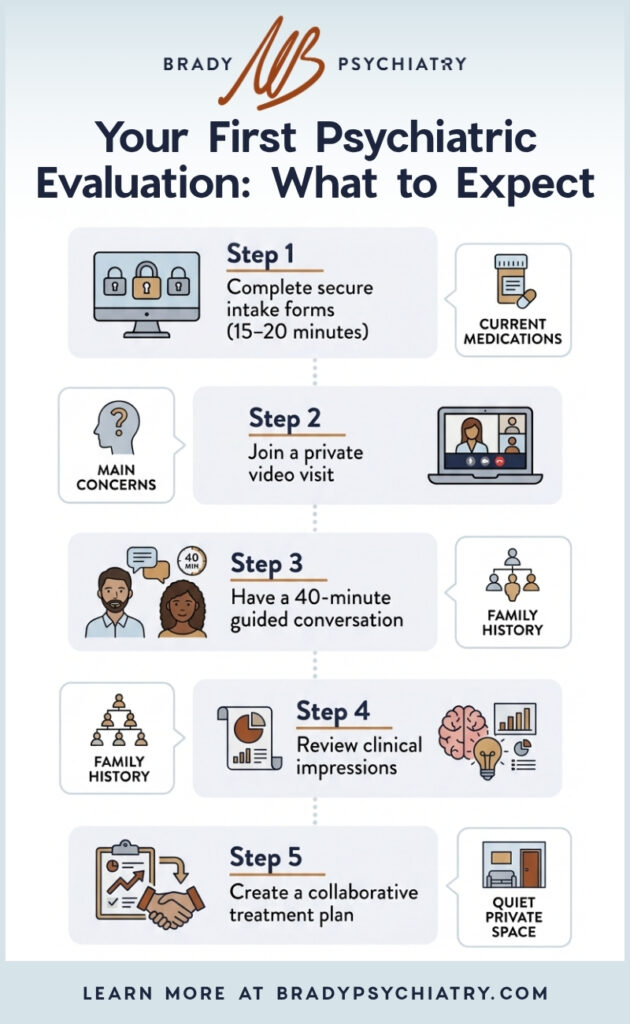
Before Your Appointment: Intake Forms
After you book your appointment through our online scheduling system, you’ll receive an email with six to eight intake forms to complete. These are handled through SimplePractice, our secure patient management platform, and can be filled out from your phone, tablet, or computer. Most people finish them in 15 to 20 minutes.
The forms cover your medical history, current medications, psychiatric history, family history, and symptom questionnaires like the PHQ-9 (depression) and GAD-7 (anxiety). There’s also a consent form for telehealth and payment authorization.
Why do we ask for all this beforehand? So Montana can review your information before your appointment and spend your time together actually talking, not filling out paperwork.
The Appointment Itself: 40 Minutes via Secure Video
Your first evaluation is a 40-minute telehealth session conducted through HIPAA-compliant video. You’ll join from wherever you’re comfortable, whether that’s your living room, your car during lunch, or a quiet room at home. All you need is a stable internet connection, a device with a camera, and a private space.
The session is structured but conversational. Montana will ask about:
- What brought you in today. What’s the main thing that’s bothering you?
- How long you’ve been experiencing symptoms and how they’ve changed over time.
- How your symptoms are affecting your daily life, including work, relationships, sleep, and energy.
- Your medical and psychiatric history, including any previous diagnoses or treatments.
- Current medications, supplements, and any substances you use.
- Family history of mental health conditions.
- Your goals. What does “better” look like for you?
This isn’t a rapid-fire questionnaire. Montana wants to understand your story, not just your symptoms. If you’re not sure how to describe what you’re feeling, that’s okay. He’ll guide the conversation to best understand how to help.
Will I Get a Diagnosis?
In most cases, yes. By the end of your first appointment, Montana will share his clinical impressions, which typically includes a preliminary diagnosis. He’ll explain what he’s seeing, why he thinks that diagnosis fits, and what it means for treatment.
Sometimes a diagnosis is immediately clear. Other times, especially with overlapping conditions like depression and bipolar disorder, or ADHD and anxiety, it takes additional evaluation over follow-up visits to refine the picture. Montana is transparent about this. He’d rather be accurate than fast.
Your Treatment Plan
Before you log off, you’ll have a clear treatment plan. This might include:
- Medication, if appropriate. Montana will explain the options, how they work, potential side effects, and what to expect. You’re never pressured into taking medication.
- Recommendations for therapy, either with Montana (who provides psychotherapy) or a referral to a therapist in your area who specializes in your needs.
- Lifestyle modifications like sleep hygiene improvements, exercise recommendations, or stress management strategies.
- A follow-up appointment, typically scheduled within two to four weeks to check how you’re responding to treatment.
The plan is collaborative. Montana presents his recommendations, but you’re a partner in every decision. If something doesn’t feel right, say so. That’s how this works.
What You Don’t Need to Worry About
A few things that often concern people but shouldn’t:
- You don’t need a referral. Unless your insurance specifically requires one, you can come directly to Brady Psychiatry.
- You won’t be judged. Montana has heard it all. His practice exists because he believes everyone deserves someone who listens without judgment.
- You won’t be rushed. The 40-minute evaluation is designed to give you room to talk. This is not a 10-minute prescription appointment.
- You don’t have to have your thoughts perfectly organized. Bring whatever you have. Notes are helpful but not required.
Tips to Get the Most from Your First Visit
While there’s no homework required, a little preparation goes a long way:
- Bring your main concerns. What’s the number-one thing you want help with?
- List your current medications, including supplements and over-the-counter drugs.
- Think about your family history. Do any relatives have mental health conditions?
- Be honest about substance use. This isn’t about judgment; it’s about safety and accurate treatment.
- Have a quiet, private space ready for your video session.
After Your First Visit
If Montana prescribes medication, he’ll send the prescription to your pharmacy electronically. You’ll have your follow-up scheduled before you end the session. Between appointments, you can message Montana through the SimplePractice patient portal with questions or concerns.
That first visit is often the hardest step, not because it’s difficult, but because deciding to get help takes courage. Once you’ve done it, the path forward gets clearer.