
OCD is one of the most misunderstood mental health conditions. People joke about being “so OCD” when they like things organized, but clinical obsessive-compulsive disorder is nothing like a preference for neatness. It’s a condition that hijacks your thinking, floods you with unwanted intrusive thoughts, and compels you to perform rituals or mental acts that temporarily relieve the distress but ultimately reinforce the cycle.
The good news: OCD is highly treatable. The combination of specific types of therapy and medication can significantly reduce symptoms for the majority of people. But the key word is “specific.” Not all therapy works for OCD, and not all medication works equally well. Understanding your options is the first step toward getting effective help.
Understanding the OCD Cycle
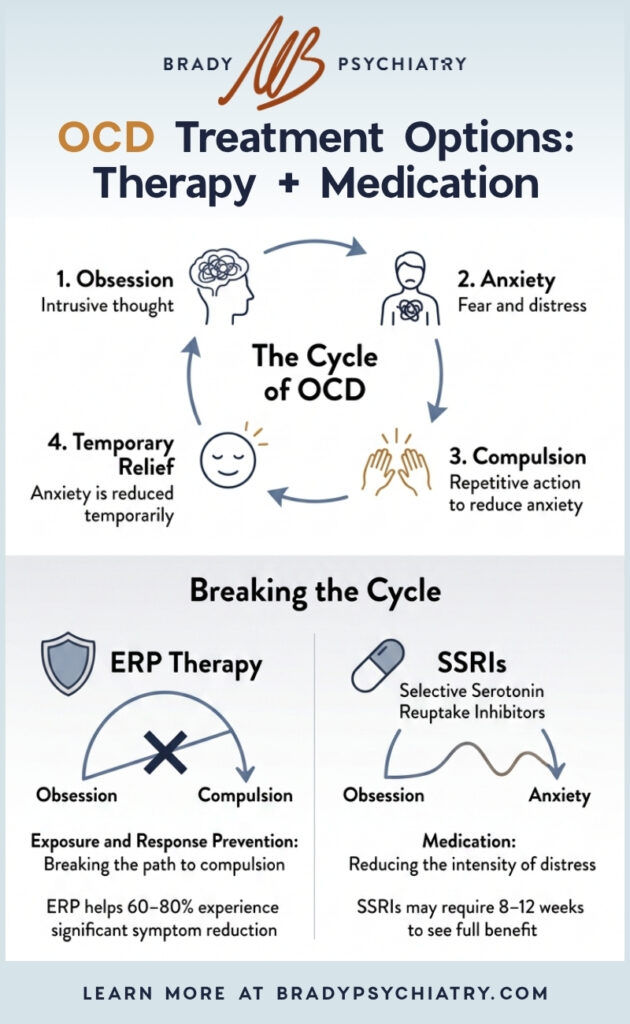
Before discussing treatment, it helps to understand what you’re treating. OCD operates in a loop:
- Obsession: An intrusive, unwanted thought, image, or urge that causes significant anxiety. Examples include fear of contamination, fear of harming someone, doubts about whether you locked the door, intrusive violent or sexual thoughts, or a need for things to be “just right.”
- Anxiety: The obsession triggers intense distress, fear, disgust, or doubt.
- Compulsion: A behavior or mental act performed to reduce the anxiety. Washing hands, checking locks, counting, repeating phrases, seeking reassurance, mentally reviewing events, or avoiding triggers.
- Temporary relief: The compulsion briefly reduces anxiety, but it reinforces the brain’s belief that the threat was real. The cycle restarts, often stronger.
Effective treatment interrupts this cycle. The two evidence-based approaches are ERP therapy and medication, ideally used together.
ERP: The Gold Standard Therapy for OCD
Exposure and Response Prevention (ERP) is the most effective psychotherapy for OCD. It’s a specialized form of CBT designed specifically for obsessive-compulsive patterns.
ERP works by gradually exposing you to the situations, thoughts, or images that trigger your obsessions and then helping you resist performing the compulsion. Over time, your brain learns that the anxiety naturally decreases on its own without the ritual. This process is called habituation.
For example, if your OCD centers on contamination fear, ERP might involve touching a doorknob and then not washing your hands, sitting with the anxiety, and noticing that it eventually passes. If your OCD involves checking, it might mean leaving the house without going back to check the stove and tolerating the uncertainty.
ERP is hard work. It asks you to do the opposite of what your OCD demands. But the research is clear: it works. Studies consistently show that 60 to 80 percent of people with OCD experience significant symptom reduction with ERP.
Not all therapists are trained in ERP. Standard talk therapy or general CBT is not a substitute. When Montana recommends therapy for OCD, he specifically refers to therapists with ERP training and experience.
Medication for OCD
The first-line medications for OCD are SSRIs, the same class of drugs used for depression and anxiety, but often at higher doses and with a longer timeline to effectiveness.
Commonly prescribed SSRIs for OCD include:
- Fluoxetine (Prozac)
- Sertraline (Zoloft)
- Fluvoxamine (Luvox)
- Paroxetine (Paxil)
- Escitalopram (Lexapro)
A few important things about SSRI treatment for OCD:
- Higher doses are often needed. The doses that effectively treat OCD are frequently higher than those used for depression or GAD. Montana will start at a standard dose and titrate up based on your response.
- It takes longer to work. While SSRIs for depression may show initial effects in two to four weeks, OCD often requires eight to twelve weeks at an adequate dose before you can fairly assess whether the medication is helping.
- Partial response is common. Medication alone typically reduces OCD symptoms by 40 to 60 percent. That’s meaningful, but it’s also why combining medication with ERP produces the best outcomes. The medication takes the edge off enough that you can engage more effectively with therapy.
Combining Therapy and Medication
For moderate to severe OCD, the combination of ERP and medication produces the best outcomes. Medication reduces the intensity of obsessions and anxiety, making it easier to engage with the challenging work of ERP. ERP builds the skills and neural pathways that create lasting change.
For mild OCD, ERP alone may be sufficient. For severe cases where anxiety is too overwhelming to engage with ERP, starting with medication first and adding therapy once symptoms are partially controlled is a common and effective strategy.
Montana will discuss which approach makes the most sense for your situation during your evaluation.
What Doesn’t Work for OCD
A few approaches that are commonly tried but aren’t effective for OCD:
- General talk therapy. Exploring your childhood or processing your feelings has value for many conditions, but it doesn’t address the OCD cycle. Without exposure and response prevention, talk therapy can actually reinforce OCD by providing another avenue for reassurance-seeking.
- Reassurance. Asking others to confirm that everything is okay feels helpful in the moment, but it functions as a compulsion. It temporarily reduces anxiety and then strengthens the cycle.
- Willpower alone. OCD is a neurobiological condition. You can’t think your way out of it through sheer determination. Effective treatment works because it changes brain patterns, not because you’re trying harder.
Living with OCD After Treatment
OCD is a chronic condition, which means it’s managed rather than cured. But managed well, it doesn’t have to run your life. Many people who complete ERP and stabilize on medication describe their OCD as background noise rather than the loudest voice in the room.
Some people stay on medication long-term. Others taper off successfully after completing a thorough course of ERP. Relapse is possible, particularly during periods of high stress, but it responds well to returning to the strategies that worked initially.