

You’ve always been the person who starts projects but doesn’t finish them. You lose your keys daily. You zone out in meetings. You procrastinate until deadlines become emergencies, then hyperfocus at the last second and somehow pull it off. You’ve been told you’re lazy, scatterbrained, or just not trying hard enough.
What if it’s ADHD?
Attention-deficit/hyperactivity disorder doesn’t go away when you turn 18. ADHD is a lifelong neurodevelopmental condition, and millions of adults are living with it undiagnosed. The symptoms just look different in adulthood than they did in childhood, which is why so many people don’t realize they have it until their 30s, 40s, or even later.
Why Adult ADHD Gets Missed
ADHD in children is often obvious: the kid who can’t sit still, blurts out answers, and disrupts class. But adults with ADHD have usually developed coping mechanisms, sometimes effective ones, that mask the underlying condition. They might have gotten through school by being smart enough to compensate. They might use caffeine, rigid routines, or sheer willpower to stay functional.
The problem is that these strategies have limits. Life gets more complicated as you age. You’re managing a career, finances, relationships, possibly children, and a household. The executive function demands multiply, and the coping mechanisms that worked at 22 start breaking down at 35.
Women are particularly underdiagnosed because ADHD in women often presents as the inattentive type: quiet disorganization, chronic forgetfulness, internal restlessness rather than visible hyperactivity. Many women are diagnosed with anxiety or depression first, and only later discover that ADHD was driving those symptoms all along.
What Adult ADHD Looks Like
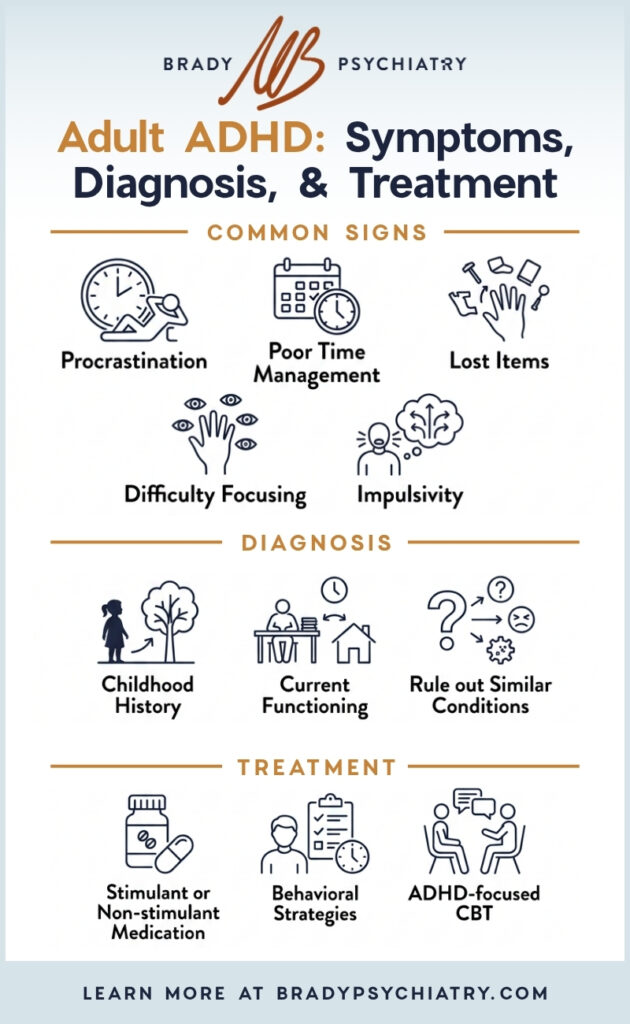
ADHD in adults commonly shows up as:
- Chronic procrastination and difficulty starting tasks, especially ones that aren’t immediately interesting.
- Trouble organizing projects, managing time, or keeping track of responsibilities.
- Frequently losing things: phone, wallet, keys, important documents.
- Difficulty sustaining attention in conversations, meetings, or while reading.
- Hyperfocus on things you find interesting, while neglecting everything else.
- Impulsive decisions, whether it’s spending, eating, or speaking without thinking.
- Emotional dysregulation: sudden frustration, sensitivity to criticism, mood swings.
- Chronic lateness and underestimating how long tasks will take.
- A sense that you’re underperforming relative to your intelligence or potential.
- Relationship strain from forgetting commitments, being inattentive, or emotional reactivity.
If you’re reading this list and feeling seen, that’s worth exploring.
How Adult ADHD Is Diagnosed
There’s no blood test or brain scan for ADHD. Diagnosis is clinical, meaning it’s based on a detailed conversation with a qualified provider who understands how ADHD presents across the lifespan.
During your 40-minute evaluation at Brady Psychiatry, Montana will explore:
- Your childhood history. ADHD symptoms must have been present before age 12, even if they weren’t recognized at the time.
- Your current symptoms and how they affect work, relationships, and daily functioning.
- Whether other conditions might be causing or contributing to your symptoms (anxiety, depression, sleep disorders, and thyroid issues can all mimic ADHD).
- Your family history, since ADHD runs strongly in families.
- Any previous evaluations or treatments you’ve tried.
Montana takes ADHD diagnosis seriously. He’s not going to hand you a stimulant prescription after a 10-minute chat. He’s also not going to dismiss your concerns because you managed to finish college. The goal is accuracy.
Treatment Options for Adult ADHD
Once diagnosed, ADHD responds well to treatment. Most adults see significant improvement with the right approach.
Medication is the most effective single intervention for ADHD. Stimulant medications (methylphenidate and amphetamine-based options) are first-line and work for the majority of people. Non-stimulant alternatives like atomoxetine or guanfacine are available for those who don’t tolerate or prefer not to take stimulants. Montana will start at a low dose and adjust based on your response.
Behavioral strategies complement medication and help you build systems that work with your brain, not against it. This includes external organization tools, breaking tasks into smaller steps, using timers, creating routines, and minimizing distractions.
Therapy, particularly CBT adapted for ADHD, can help you address the shame, frustration, and self-criticism that often accompany years of undiagnosed ADHD. It’s not about fixing what’s wrong with you; it’s about understanding how your brain works and leveraging its strengths.
Why Getting Evaluated Matters
Untreated ADHD in adults is associated with higher rates of anxiety, depression, substance use, job instability, relationship problems, and financial difficulties. Getting an accurate diagnosis doesn’t just explain your past; it changes your future. Many adults describe their diagnosis as the moment things finally made sense.
You’re not lazy. You’re not broken. You might just have a brain that works differently, and there are effective treatments for that.