

If you’ve been prescribed psychiatric medication, or you’re considering it, you’ve probably heard the term “medication management.” It sounds clinical and vague, and most people aren’t sure what it actually involves beyond “the doctor checks your meds.”
Here’s the straightforward version: medication management is the ongoing process of making sure your psychiatric medication is working as well as it can, with as few side effects as possible. It’s not a one-and-done prescription. It’s a relationship between you and your provider that continues as long as you’re on medication.
At Brady Psychiatry, Montana Brady, PMHNP, takes medication management seriously. Here’s what the process actually looks like.
It Starts with Your Evaluation
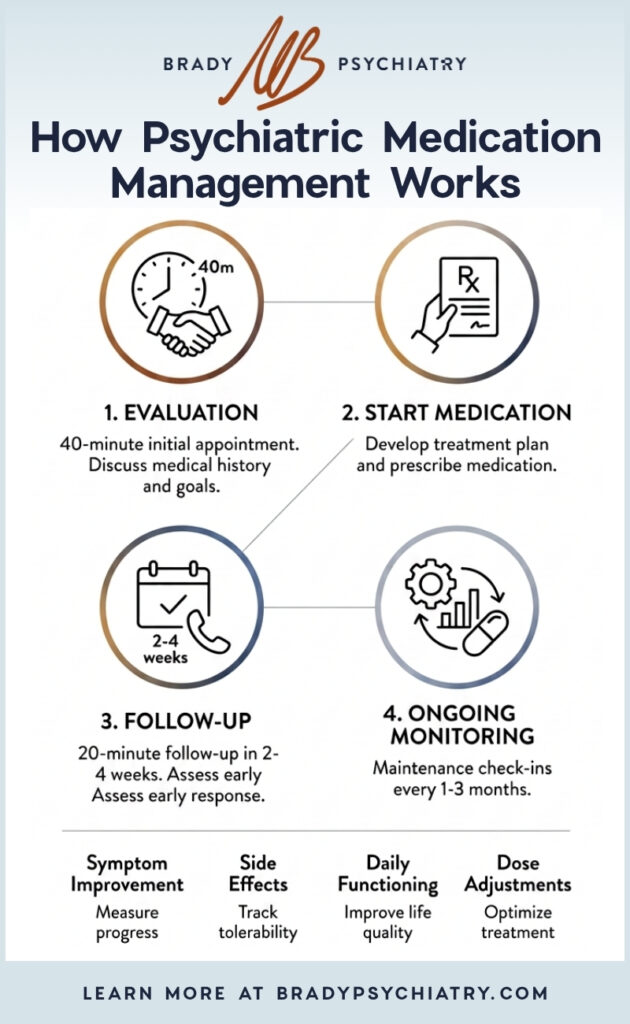
Before any medication is discussed, Montana needs to understand what’s going on. Your first appointment is a 40-minute evaluation where he assesses your symptoms, history, current medications, family history, and goals. Not everyone needs medication, and Montana won’t recommend it unless the clinical picture supports it.
If medication is appropriate, Montana will explain:
- Why he’s recommending a specific medication over alternatives.
- How the medication works in plain language, not pharmacology textbook.
- What side effects to watch for and which ones typically fade after the first few weeks.
- How long it takes to feel the effects (most psychiatric medications take two to six weeks to reach full effectiveness).
- What to do if you experience a problem before your next appointment.
You’ll never be pressured. Medication is a tool, not a requirement, and the decision to use it is always collaborative.
The First Few Weeks: What to Expect
Starting a new psychiatric medication is not like taking an antibiotic where you feel better in 48 hours. Most medications for depression, anxiety, ADHD, and other conditions take time to build up in your system. During this adjustment period, you might notice:
- Mild side effects that often resolve within one to two weeks (nausea, headache, sleep changes, dry mouth).
- Partial improvement: things might get a little better before they get a lot better.
- No change at all in the first week or two, which is normal and not a sign the medication isn’t working.
Montana will typically schedule your first follow-up within two to four weeks of starting a new medication. This is intentional. He wants to check in while the medication is still early enough to adjust if needed.
What Happens During a Follow-Up
Follow-up appointments at Brady Psychiatry are 20-minute telehealth sessions. They’re shorter than your initial evaluation because Montana already has your history. The focus is targeted:
- Symptom check. Are your symptoms improving? Staying the same? Getting worse? Montana will ask specific questions about the symptoms you’re being treated for, not just a general “how are you feeling?”
- Side effects. Are you experiencing any? How severe are they? Are they tolerable or interfering with your life? Some side effects are expected and temporary. Others signal that a different medication or dosage would work better.
- Functional assessment. Beyond symptom scores, Montana looks at how you’re actually functioning. Are you sleeping better? Is your concentration improving? Can you get through a workday without crashing? Are your relationships less strained? These real-world markers matter more than a number on a screening questionnaire.
- Medication adjustments. Based on your response, Montana might increase the dose, decrease it, switch to a different medication, or add a second medication to address residual symptoms. Each change is explained so you understand the reasoning.
- Your questions. Follow-ups are your time too. If you’ve noticed something, read something, or have a concern about your medication, this is the place to raise it.
How Often Do You Need Follow-Ups?
The frequency depends on where you are in treatment:
- Starting a new medication: Every two to four weeks until stable.
- After a dosage change: Two to four weeks to assess the adjustment.
- Once stable: Every one to three months for maintenance. Even when things are going well, periodic check-ins ensure your medication continues to work and catch any emerging issues early.
The goal is to find the right medication at the right dose with minimal side effects, then maintain that stability with regular but less frequent monitoring.
Why Medication Management Matters
Psychiatric medication without follow-up is like getting glasses without a fitting. It might be close, but it probably isn’t right. Many people who feel like “medication didn’t work for me” actually experienced a medication that wasn’t optimized, the dose was wrong, the medication wasn’t the best fit, or side effects drove them to stop without trying alternatives.
Proper medication management addresses all of this. It’s the difference between trying one thing, giving up, and concluding that medication doesn’t work for you, versus systematically working through options until you find what does.
What Medication Management Is Not
A few things worth clarifying:
- It’s not a prescription mill. Montana doesn’t prescribe medication to everyone who walks through the door. If your symptoms don’t warrant it, or if therapy alone is a better fit, he’ll say so.
- It’s not a replacement for therapy. Medication manages symptoms. Therapy builds skills and addresses root causes. For many conditions, the combination is more effective than either alone.
- It’s not necessarily forever. Some people take psychiatric medication for a defined period and taper off. Others benefit from long-term use. There’s no one-size-fits-all answer, and Montana will discuss the timeline based on your specific situation.
Getting Started
If you’re currently on medication and don’t feel like it’s working, or if you’ve been thinking about medication but aren’t sure where to start, a conversation with Montana is the right first step. He’ll take the time to evaluate your situation and build a plan that makes sense for you.