
The short answer is yes. And for many people with anxiety, telehealth isn’t just a workaround — it’s actually the better option.
If you’re dealing with anxiety or panic attacks, the idea of scheduling an in-person appointment, driving to an unfamiliar office, sitting in a waiting room full of strangers, and then talking about your most vulnerable experiences probably doesn’t sound appealing. For some people, it sounds impossible. The very condition you’re trying to treat can make it harder to access treatment.
Telehealth removes that barrier. At Brady Psychiatry, Montana Brady, PMHNP, provides comprehensive psychiatric care for anxiety and panic disorders entirely through secure video. Same clinical rigor, same prescribing authority, same quality of care minus the waiting room.
What the Research Says
This isn’t a matter of opinion or convenience. The evidence is clear: telehealth-delivered psychiatric care for anxiety disorders produces outcomes equivalent to in-person treatment. Multiple studies have confirmed this across generalized anxiety disorder (GAD), panic disorder, social anxiety, and specific phobias.
In some cases, outcomes are actually better via telehealth. Patients with anxiety attend appointments more consistently when they don’t have to travel. They’re more comfortable in their own environment, which means they communicate more openly. And for people with panic disorder or agoraphobia, eliminating the physical trip to an office can be the difference between getting care and going without it.
The American Psychiatric Association and the National Institute of Mental Health both support telepsychiatry as an effective delivery method for anxiety treatment.
How Anxiety and Panic Treatment Works via Telehealth
Your treatment at Brady Psychiatry follows the same clinical pathway as an in-person practice:
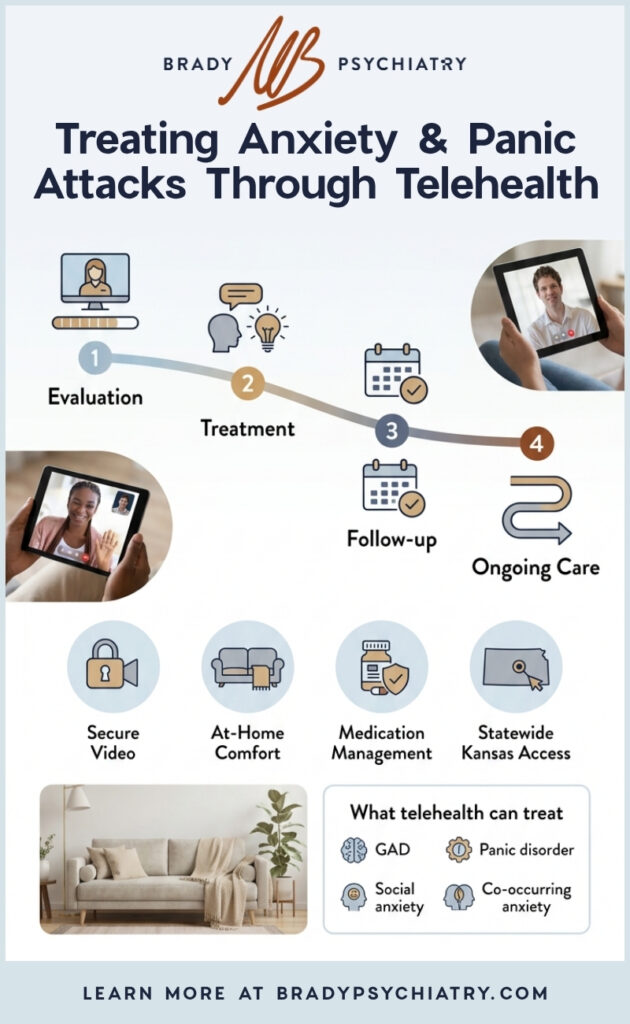
- Step 1: Evaluation. Your first appointment is a 40-minute session where Montana gets to know you. He’ll ask about your anxiety symptoms, when they started, how they affect your daily life, your medical and psychiatric history, family history, and what you’ve tried before. He’ll assess whether you’re dealing with GAD, panic disorder, social anxiety, a specific phobia, or a combination. By the end of the session, you’ll have a preliminary diagnosis and a treatment plan.
- Step 2: Treatment initiation. Depending on your diagnosis and severity, treatment might include medication (typically an SSRI or SNRI), a recommendation for therapy, lifestyle modifications, or a combination. If Montana prescribes medication, it’s sent to your pharmacy electronically. If he recommends therapy, he can refer you to a therapist who specializes in your specific type of anxiety.
- Step 3: Follow-up. You’ll have your first follow-up within two to four weeks. Montana checks how you’re responding to treatment, whether side effects are manageable, and whether the plan needs adjustment. These sessions are 20 minutes and happen via video, just like your evaluation.
- Step 4: Ongoing management. Once you’re stable, follow-ups space out to every one to three months. But you’re never cut off. The SimplePractice patient portal lets you message Montana between appointments with questions or concerns.
What Telehealth Can Treat
Montana treats the full spectrum of anxiety disorders through telehealth:
- Generalized Anxiety Disorder (GAD): Chronic, excessive worry about multiple areas of life that’s difficult to control. GAD responds well to both medication and CBT, and both can be delivered or coordinated via telehealth.
- Panic Disorder: Recurrent panic attacks, sudden episodes of intense fear with physical symptoms like racing heart, shortness of breath, chest tightness, and dizziness. Panic disorder is highly treatable with SSRIs and CBT. Telehealth is especially effective here because many people with panic disorder have developed avoidance patterns that make leaving the house difficult.
- Social Anxiety Disorder: Intense fear of social situations. People with social anxiety often avoid seeking in-person care because the appointment itself triggers their symptoms. Telehealth lets them access treatment from a safe, familiar environment.
- Anxiety related to other conditions: Anxiety frequently co-occurs with depression, ADHD, PTSD, and OCD. Montana evaluates for co-occurring conditions so the treatment plan addresses the full picture.
When Telehealth Works Best for Anxiety
Telehealth is ideal for anxiety treatment when:
- You live in a rural area or far from a psychiatric provider.
- Long waitlists at local practices mean you’d be waiting months for an appointment.
- Your anxiety itself makes in-person appointments difficult (driving anxiety, social anxiety, agoraphobia).
- You want the convenience of appointments from home, your office, or wherever you have privacy.
- You have a busy schedule and can’t afford half a day for a 30-minute appointment when you factor in driving and waiting.
- You want continuity of care from the same provider regardless of where you are in Kansas.
What Telehealth Can’t Do
Telehealth handles the vast majority of anxiety treatment, but there are a few things that require coordination with your primary care provider:
- Physical exams. If Montana suspects a medical condition is contributing to your anxiety (like thyroid dysfunction or cardiac issues), he’ll order labs through your PCP.
- In-person crisis stabilization. If you’re in immediate danger, call 911. If you’re experiencing a mental health crisis, call or text 988. Telehealth is designed for ongoing treatment, not emergency intervention.
Everything else (evaluation, diagnosis, medication prescribing, dose adjustments, therapy recommendations, care coordination, and long-term monitoring) works through telehealth.
Getting Past the “What If” Loop
If you have anxiety, you’re probably already running through reasons not to make the appointment. What if he doesn’t understand? What if I can’t explain what’s wrong? What if the medication makes it worse? What if this doesn’t work either? That’s anxiety doing what anxiety does, generating what-ifs to keep you stuck.
Here’s what’s actually true: you don’t need to have your thoughts organized. Montana will guide the conversation. You don’t need to commit to medication before your first appointment. You just need to show up to a 40-minute video call and be honest about what’s going on.
That’s it. One video call. From your couch.